Looking for the best dehumidifier for basement? If you’ve ever dealt with a damp basement, you know how frustrating it can be—the musty smell, sticky air, and constant fear of mold taking over your space. I faced this problem when my basement started smelling like a wet towel, and my stored boxes felt damp. After some research (and buying the wrong model the first time), I finally found the best dehumidifier for my basement, and it completely transformed the space.
If you’re searching for the best dehumidifier for basement, here’s everything I learned firsthand that can help you make the right choice.
Why You Need a good dehumidifier for basement
Before buying one, ask yourself why you need it. For me, it was about protecting my stored belongings and improving the air quality. But a good basement dehumidifier can do much more:
- Reduce musty odors and improve air freshness.
- Prevent mold and mildew growth.
- Protect furniture, electronics, and stored items.
- Make the space livable if you use it as a laundry room, home gym, or entertainment area.
If you’ve got a musty smell, visible condensation, or damp walls, a dehumidifier is a must-have.
Step 1: Measure Your Basement Size
One of the most common mistakes (and one I almost made) is buying a dehumidifier that’s too small. Dehumidifiers are rated by how many pints of moisture they can remove per day.
Here’s a simple guide:
- Small basements (under 1,500 sq. ft.): 20–30 pint dehumidifier.
- Medium basements (1,500–2,500 sq. ft.): 30–50 pint dehumidifier.
- Large basements (over 2,500 sq. ft.): 50–70 pint dehumidifier.
Pro tip: If in doubt, size up. A slightly larger model will save you from constantly emptying the water tank.
Step 2: Choose Your Drainage Option
When I first bought my dehumidifier, I relied on the built-in water bucket. It worked fine, but emptying it every couple of days got old quickly.
For convenience, look for:
- Continuous drainage: Attach a hose to drain water directly into a floor drain or sink.
- Built-in pump: A premium feature that allows water to be pumped out—even uphill—into a sink or window.
If you want a “set it and forget it” solution, go for a model with continuous drainage.
Step 3: Look for Must-Have Features
The best dehumidifiers for basements aren’t just about size—they come with features that make your life easier:
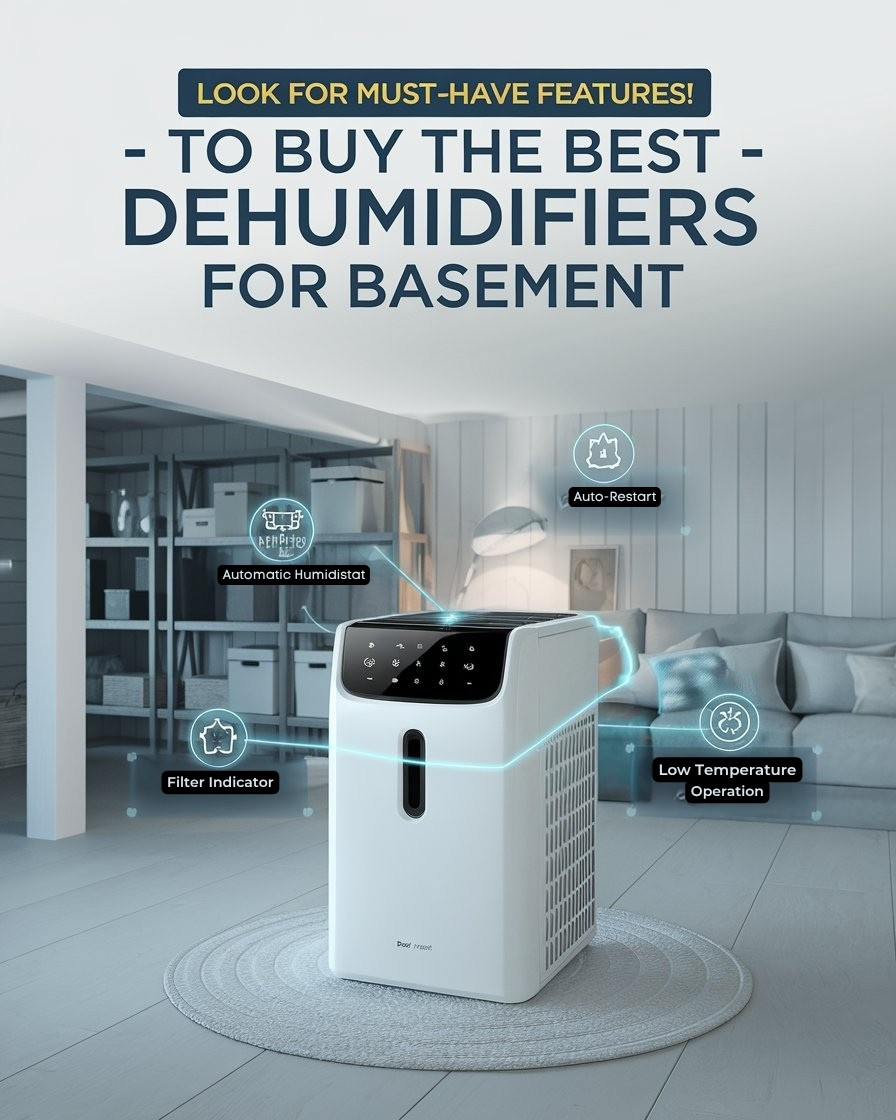
- Automatic humidistat: Set your preferred humidity level, and the unit adjusts itself.
- Auto-restart: Restores settings after a power outage.
- Filter indicator: Reminds you to clean the filter for better efficiency.
- Low-temperature operation: Prevents coil freezing if your basement gets cold in winter.
These features made my dehumidifier practically maintenance-free.
Step 4: Consider Noise Levels
If you spend time in your basement for laundry, workouts, or entertainment, noise matters. My first unit was loud enough to be distracting, so I switched to a model with a quiet mode, which made a big difference.
Step 5: Check Energy Efficiency
Dehumidifiers often run for hours each day. Look for Energy Star-certified models—they’re designed to save energy without compromising performance. I noticed a drop in my energy bills after switching to one.
My Recommendation: Don’t Skimp on Quality
After living with multiple models, here’s my takeaway: a high-quality dehumidifier is worth every penny. My basement is no longer musty, my things stay dry, and I don’t stress about mold.
If I were buying again, I’d choose:
- A 50–70 pint dehumidifier for more capacity.
- Continuous drainage with a pump for convenience.
- Automatic controls for hands-off operation.
Final Thoughts
The best dehumidifier for basement aren’t just about drying the air—it protect your home, improve air quality, and give you peace of mind. When choosing one, match the size to your basement, opt for convenient drainage, and prioritize energy efficiency.